
Cataract Surgery in Bhopal: When Is It Time to Consider Surgery?
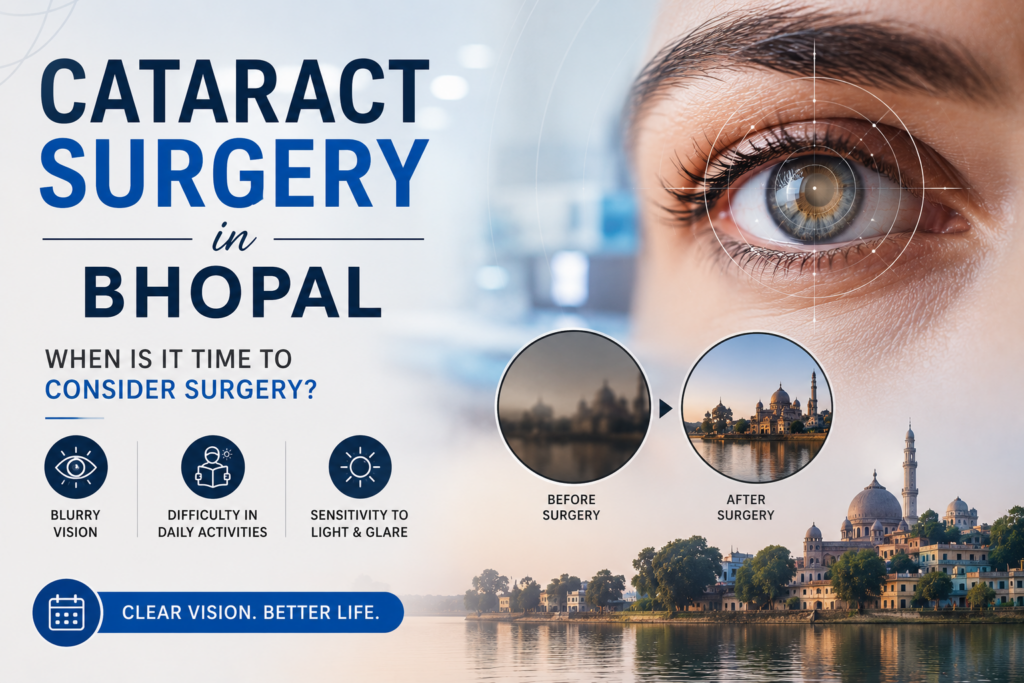
If you’re searching for cataract surgery in Bhopal, you may have noticed that everyday activities are becoming slightly more difficult — reading a newspaper, driving at night, watching television, recognizing faces from a distance, or seeing clearly in bright sunlight.
Cataracts often develop gradually, which means many people adjust to changing vision without immediately realizing how much their eyesight has deteriorated.
The good news is that cataracts are treatable. Cataract surgery removes the cloudy natural lens and replaces it with an artificial intraocular lens (IOL). The National Eye Institute describes surgery as the treatment that removes a cataract, although surgery does not necessarily have to happen immediately after diagnosis.
At Hi-Tech Eye Care & Laser Centre in Vidya Nagar, Hoshangabad Road, Bhopal, cataract surgery is part of the centre’s comprehensive ophthalmic services, including stitchless phacoemulsification and advanced lens options.
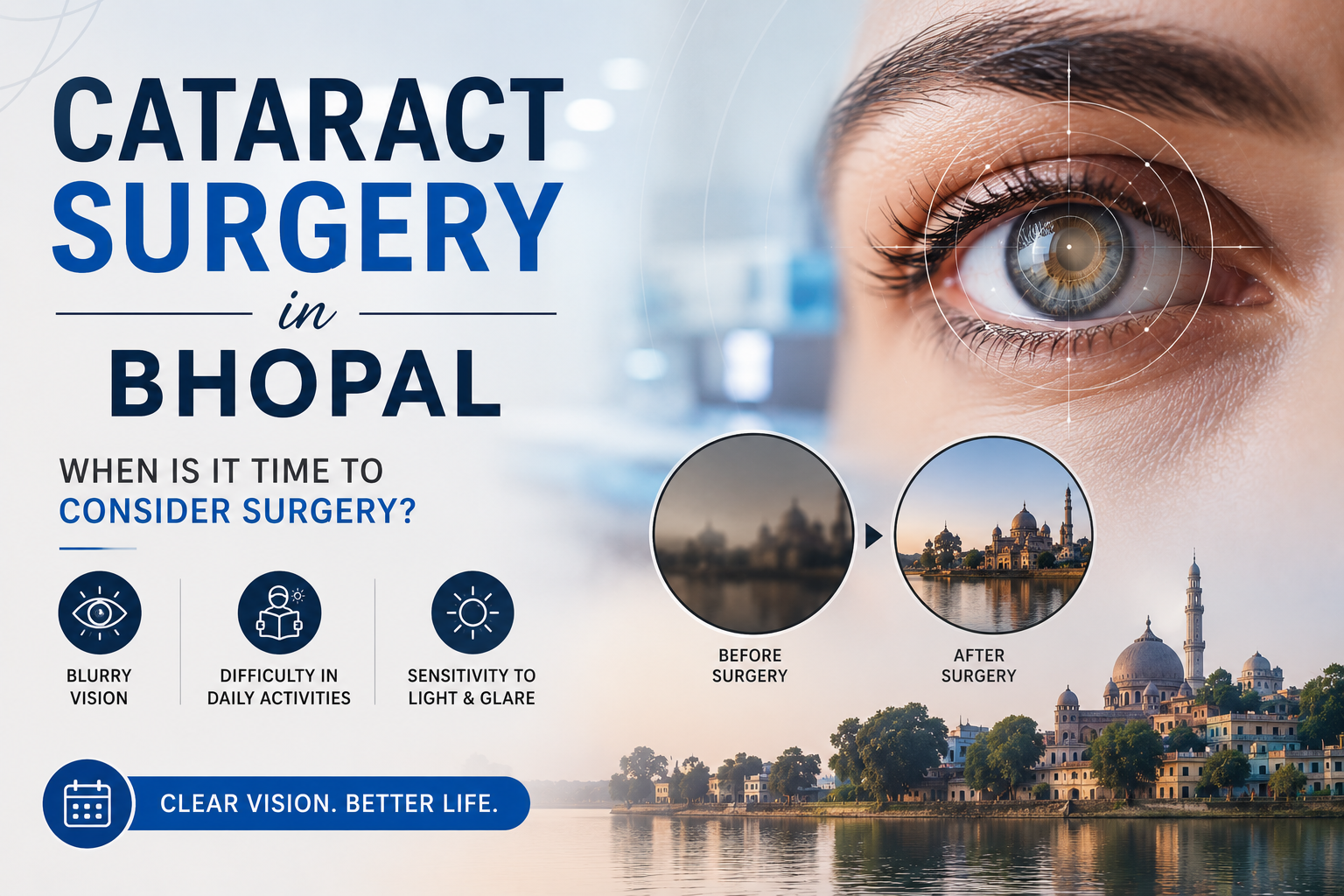
What Is a Cataract?
A cataract occurs when the normally clear lens inside the eye becomes cloudy.
The lens normally focuses light onto the retina so that you can see clearly. As a cataract develops, the lens becomes less transparent and vision can gradually become cloudy, hazy or less sharp.
Cataracts are commonly associated with ageing, but they can also occur due to factors such as diabetes, previous eye injury, certain medications and other eye conditions.
What Are the Common Symptoms of Cataracts?
Cataracts don’t always cause noticeable symptoms when they first develop.
As they progress, you may experience:
- Blurry or cloudy vision
- Difficulty seeing at night
- Increased sensitivity to bright lights
- Glare from headlights
- Halos around lights
- Faded colours
- Double vision in some cases
- Frequent changes in your glasses prescription
These symptoms can also occur with other eye conditions, so a comprehensive eye examination is important before assuming that a cataract is the cause.
When Should You Consider Cataract Surgery?
A cataract diagnosis does not automatically mean that you need surgery immediately.
The more important question is:
How much is the cataract affecting your daily life?
An ophthalmologist may discuss surgery when vision loss starts interfering with activities such as:
- Reading
- Driving
- Watching television
- Working
- Using a computer
- Recognizing faces
- Moving around safely
- Performing everyday household activities
The National Eye Institute notes that cataract surgery is generally considered when cataract-related vision loss interferes with everyday activities.
This means there is no single “correct” visual acuity number at which every patient must have cataract surgery. Your symptoms, examination and lifestyle all matter.
Is Cataract Surgery Safe?
Cataract surgery is one of the most commonly performed eye surgeries and is generally considered safe and effective.
However, like any surgical procedure, it has potential risks. These can include infection, bleeding, changes in eye pressure, retinal complications and other postoperative problems.
Your ophthalmologist should evaluate your eyes and medical history and explain the expected benefits and potential risks before surgery.
What Happens During Cataract Surgery?
During cataract surgery, the cloudy natural lens is removed and replaced with an artificial lens called an intraocular lens (IOL).
Modern cataract surgery commonly uses very small surgical incisions and advanced techniques.
At Hi-Tech Eye Care & Laser Centre, the listed cataract service includes stitchless phacoemulsification, along with advanced lens options.
The exact procedure and lens choice depend on the individual patient’s eye measurements, lifestyle, visual requirements and clinical condition.
What Is Phacoemulsification?
Phacoemulsification is a modern cataract surgery technique in which the cloudy natural lens is broken up and removed through a small incision before an artificial intraocular lens is placed inside the eye.
The technique is widely used in modern cataract surgery.
However, the best surgical approach is not determined by marketing terminology alone. Your ophthalmologist should examine your eye and recommend the appropriate procedure.
Understanding Intraocular Lens Options
One of the most important decisions surrounding cataract surgery is the choice of IOL.
Different lens designs can provide different types of vision.
Depending on your eye and visual requirements, your ophthalmologist may discuss options such as:
- Monofocal lenses
- Multifocal lenses
- Extended-depth-of-focus lenses
- Toric lenses for suitable patients with astigmatism
Not every lens is suitable for every patient.
The choice should be based on factors such as your corneal health, retina, existing eye conditions, lifestyle and expectations.
Cataract Surgery and Diabetes
Diabetes can increase the risk of developing cataracts and can also be associated with other retinal conditions.
For this reason, people with diabetes should have their overall eye health evaluated rather than treating cataract surgery as an isolated procedure.
If retinal disease such as diabetic retinopathy is present, it may also influence the patient’s visual outcome and treatment plan.
Hi-Tech Eye Care & Laser Centre provides both cataract and diabetic/retina care, allowing patients to have multiple aspects of their eye health evaluated within the same centre.
What Is Recovery Like After Cataract Surgery?
Recovery varies from person to person.
Your ophthalmologist may prescribe eye drops and recommend precautions while the eye heals. Follow-up appointments are important for checking the healing process and monitoring vision.
Some patients experience mild discomfort, sensitivity to light or temporary blurred vision immediately after surgery.
You should contact your eye doctor promptly if you experience significant pain, sudden vision loss, severe redness, flashes of light or a sudden increase in floaters after surgery.
Why Choose an Eye Hospital in Bhopal With Complete Eye Care?
Cataract patients may have other eye conditions that need to be considered before or after surgery.
For example, a patient may also have:
- Glaucoma
- Diabetic retinopathy
- Corneal disease
- Retinal disease
- Dry eye
- Refractive errors
Having access to comprehensive ophthalmic services can make evaluation and follow-up more convenient.
Hi-Tech Eye Care & Laser Centre offers cataract, glaucoma, retina and diabetic eye care, LASIK/PRK, pediatric eye care and corneal services from its Vidya Nagar location.
Why Bhopal Patients Shouldn’t Ignore Changing Vision
Many people gradually adapt to cataract-related vision loss.
You may start avoiding night driving, increase the brightness of your television, move closer to the screen or simply assume that ageing is responsible for the change.
But worsening vision deserves an eye examination.
A cataract may be responsible — but other eye conditions can produce similar symptoms.
Getting the correct diagnosis is the first step toward deciding whether observation, updated glasses or cataract surgery is appropriate.
Cataract Care at Hi-Tech Eye Care & Laser Centre, Bhopal
Located in Vidya Nagar on Hoshangabad Road, Hi-Tech Eye Care & Laser Centre provides comprehensive ophthalmic care in Bhopal.
Its listed cataract services include modern stitchless phacoemulsification and advanced lens options, supported by a broader range of eye-care specialties.
If cloudy vision, glare or difficulty seeing at night is interfering with your everyday life, schedule a comprehensive eye examination to determine whether cataracts or another eye condition may be responsible.